Kinzen (now Spotify)
Building Trust in News: From Zero to Acquisition
Kinzen | Design & Research Lead | 2017-2022
Overview
In 2017, I joined three founders tackling the disinformation crisis as the first designer at Kinzen. Over 18 months, I built the design function from scratch, led research with hundreds of users, and shipped a consumer app that hit #1 in Ireland's App Store. When we pivoted to enterprise, I scaled to an eight-person team creating trust and safety tools that helped detect disinformation for governments and platforms—work that contributed to Spotify's acquisition in 2022.
The Problem
Post-Cambridge Analytica, the news ecosystem was broken. Readers were drowning in information noise—algorithms rewarded clickbait over quality journalism, filter bubbles trapped people in echo chambers, and nobody felt in control of what they read or who to trust.
The founders, former heads of media partnerships at Facebook and Twitter, had seen this crisis from inside the platforms. They knew tech companies wouldn't fix it themselves. Someone had to design a better way for people to find, trust, and consume news.
Discovery: Starting with Nothing
Building Process, Not Just Product
Day one: three founders, one engineer, me. The CTO was in South Africa. Everyone had ideas—the initial pitch was a Twitter chatbot. But I pushed us to step back. Before jumping to solutions, we needed to understand the actual problems and who we were solving for.
I ran cross-functional workshops, facilitated whiteboarding sessions, and created a design knowledge base to capture and synthesise everything. This wasn't just about alignment—it was about establishing how a brand-new team would work together.
Understanding How People Actually Consume News
I led comprehensive user research to understand real behaviour not what people said they did, but what they actually did:
• Dozens of 1-to-1 interviews (in-person and video calls)
• Survey to 200 people
• Diary studies tracking how news consumption changed throughout the day
Three patterns emerged:
• People felt zero control, algorithms decided what they saw
• News consumption felt unhealthy, like junk food for the mind
• They knew they were trapped in filter bubbles but had no trusted way to explore beyond them
Testing Ideas Fast
I created 18 personalised prototypes to test different approaches to giving people control. Each prototype was tailored to the person we interviewed, some saw metrics about their information diet (source diversity, bias indicators), others saw productivity features (time limits, scheduled digests), and everyone saw different ways to explore beyond their usual topics.
Through weekly moderated testing sessions, we learned:
• Showing problems without solutions creates frustration. Metrics like 'your sources lack gender diversity' need actionable ways to fix them
• Productivity controls (time limits, digest scheduling) had highest perceived value—people wanted control over when and how much
• News needs change throughout the day. Morning = quick headlines over coffee. Evening = deeper analysis
The Kinzen App: News Based on Who You Are
The Core Insight
Research showed people wanted news that reflected their identity, not just interests, but where they're from, what they do, and most importantly, who they trust. Generic algorithmic feeds ignored this. We needed to let people build their news experience around multiple dimensions of identity.
I designed the app around four identity pillars that users could mix and match:
• Place: Local news specific to your location
• Profession: Industry news relevant to your work
• Interests: Topics you care about
• Sources: Specific publications you trust
Users created custom 'channels' around any combination. Your morning could be hyperlocal + tech industry news. Your evening could be longform journalism about culture. Full control, no algorithm deciding for you.
Solving the Cold Start Problem
Building your own channels takes time. We needed a way for people to get value immediately. The breakthrough: recruit experts to create pre-made channels.
We built a community of 200 curators, people with genuine expertise who hand-picked sources for specialised topics: mental health, climate policy, independent cinema, local politics. These weren't influencers or algorithms. They were trusted humans.
New users could onboard in seconds by adding expert-curated channels, then customise from there. We backed this with 3,500 hand-picked news sources, searchable by topic and location. This solved two problems at once: fast onboarding and trusted discovery beyond filter bubbles.
Key Features I Designed
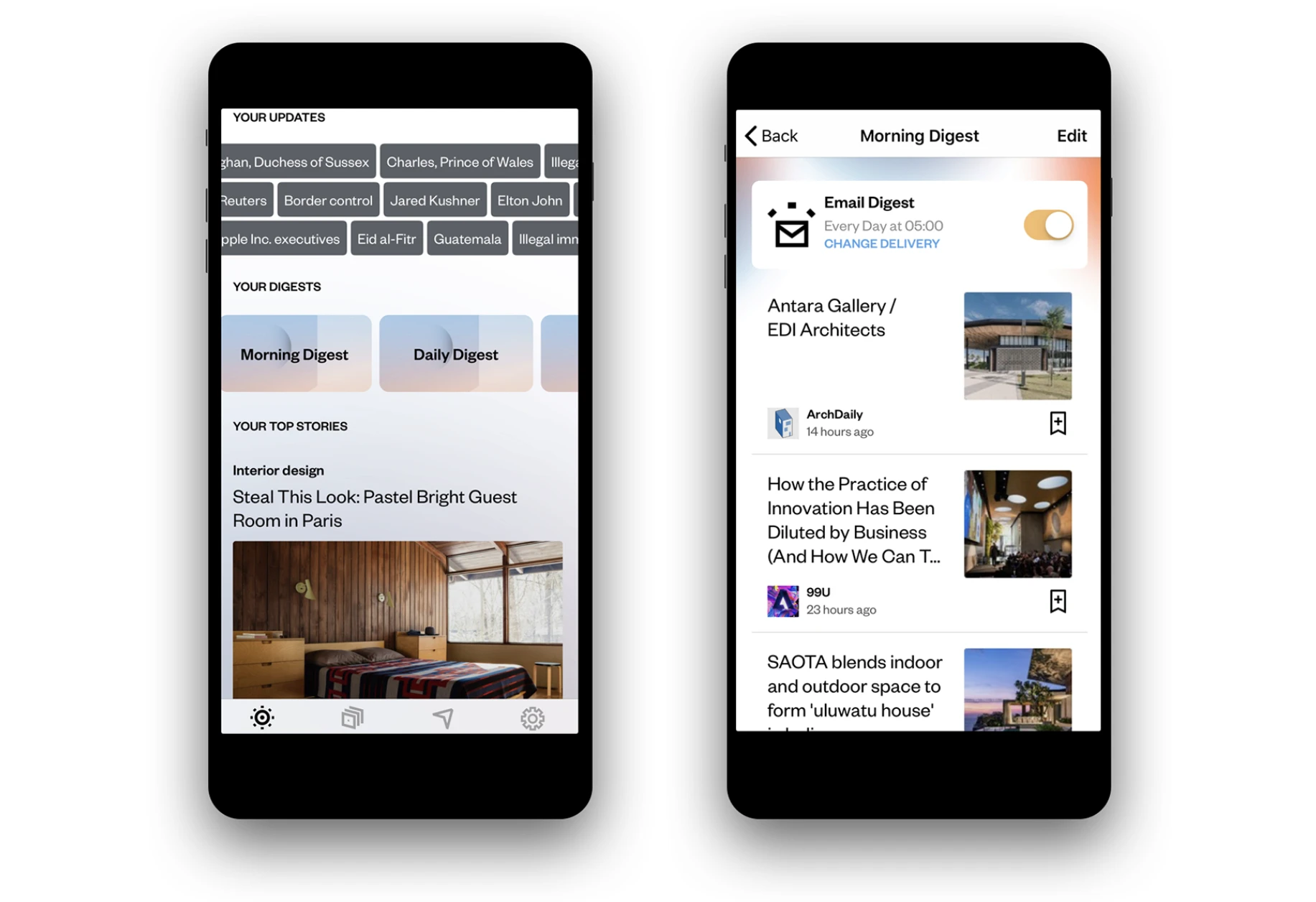
Discovery Cloud
To help people explore beyond their chosen channels, I designed an opt-in discovery cloud at the top of the feed, trending topics and editor picks that exposed you to quality content outside your comfort zone. Exploration without algorithmic manipulation.
Custom Digests & Newsletters
People wanted news routines that fit their day. I designed a digest builder: choose your channels, set the time (morning, lunch, evening), optionally deliver it to your inbox as a newsletter. Full control over what, when, and how.
Channel Controls
Within each channel, users could block specific topics, promote certain sources, or adjust how much weight to give editor curation versus their own preferences. Granular control without overwhelming complexity.
Launch & Learning
We launched the iOS app and hit #1 in Ireland's App Store. Users responded to the focus on reducing noise and giving them exploration tools they could trust. Post-launch, I set up daily feedback monitoring through Intercom, every morning I reviewed user comments, logged bugs in Asana, and added feature requests to the backlog.
But success had limits:
What Worked | What Didn't |
Early, extensive research with hundreds of users | Not enough data volume for ML to improve quickly |
Expert-curated channels (200 curators) | Tried solving too many problems at once |
User control (channels, digests, time-based) | Changing habits is brutally hard—people returned to Twitter |
Cross-functional team collaboration | Underinvested in guided onboarding |
The Pivot: From Consumer to Enterprise
Why We Changed Direction
The consumer app proved our approach worked, we could help people find quality news and break out of filter bubbles. But we hit the reality of consumer behaviour: changing daily habits is incredibly hard, even with a better product. Meanwhile, governments, NGOs, and platforms were desperate for tools to detect and respond to disinformation at scale.
Kinzen pivoted to enterprise. The mission stayed the same (help people navigate the information crisis), but the users changed. Instead of news readers, we'd design for trust and safety teams, content moderators, and policy researchers.
Scaling Design for Different Problems
Enterprise meant designing for power users with completely different needs:
• Moderation teams analysing thousands of posts per day, needing to spot coordinated campaigns
• Researchers tracking emerging disinformation narratives across languages and platforms
• Policy teams setting detection thresholds and defining response protocols
I created unified design systems for content classification and quality assessment tools—making complex machine learning outputs understandable and actionable. Data visualization became critical: How do you show credibility at scale? How do you surface narrative patterns? How do you enable drill-down from macro trends to individual pieces of content?
Shaping the Enterprise Story
I worked closely with founders and go-to-market teams to align our product narrative and pilot strategy. Design wasn't just about interfaces anymore—it shaped how we positioned trust-first technology to enterprise customers. The core philosophy stayed the same: give people control, transparency, and tools they can trust. We just scaled it from individual news readers to professional trust and safety teams.
Impact
• Built design function from zero to eight-person organization
• #1 App Store ranking in Ireland for consumer app
• 200-person expert curator community with 3,500 hand-picked sources
• Design systems for disinformation detection and content classification at scale
• Trust-first product identity that contributed to Spotify's acquisition (2022)
What I Learned
Build Process Before You Build Product
At a five-person startup, establishing how we'd work mattered more than what we'd build. The workshop processes, knowledge base, and shared language I created in week one lasted through acquisition. This taught me that early-stage design leadership is as much about culture and methodology as craft.
Human Expertise Beats Algorithms for Trust
The 200 expert curators became our most successful feature because they combined human judgment with technology. People trust people more than they trust algorithms—especially in news. This principle carried through to enterprise: our trust and safety tools always kept humans in control of final decisions.
Research Needs Systems, Not Just Sessions
Hundreds of interviews only create value if you have systems to capture insights, synthesize patterns, and make findings accessible to the whole team. The knowledge base and research documentation I built became our source of truth—helping new team members understand decisions made months earlier.
Pivots Require Maintaining Core Principles
Moving from consumer to enterprise felt like starting over, but the underlying philosophy stayed constant: give people control, transparency, and tools they trust. This continuity made the pivot feel less jarring—we weren't abandoning our values, just applying them to different users with different problems.
"Eilis was responsible for creating the culture that has defined Kinzen. She quickly established herself as an advocate for the user, eventually taking the role of product manager in addition to her work on research and design. Eilis provided leadership as we designed, tested and shipped an ambitious consumer app, demonstrating that very rare combination of people-skills and process-skills. As CEO, I came to depend on Eilis's open, honest and inspired feedback."
— Mark Little, CEO & Founder, Kinzen